Effective contamination control begins with facility design rather than equipment selection. A commercial barrier washer installation forms one part of a complete workflow that separates dirty and clean processing areas, validates disinfection and supports healthcare compliance. Econic Laundry Solutions designs integrated barrier laundry systems that consider operational capacity, infection-control requirements and long-term production performance before recommending equipment.
Every contaminated sheet, towel and patient gown entering a healthcare laundry must remain separated from clean textiles throughout processing. A barrier washer installation supports that objective by physically separating dirty and clean workflows. The machine, however, forms only one part of an effective contamination-control system.
Contamination Pathways
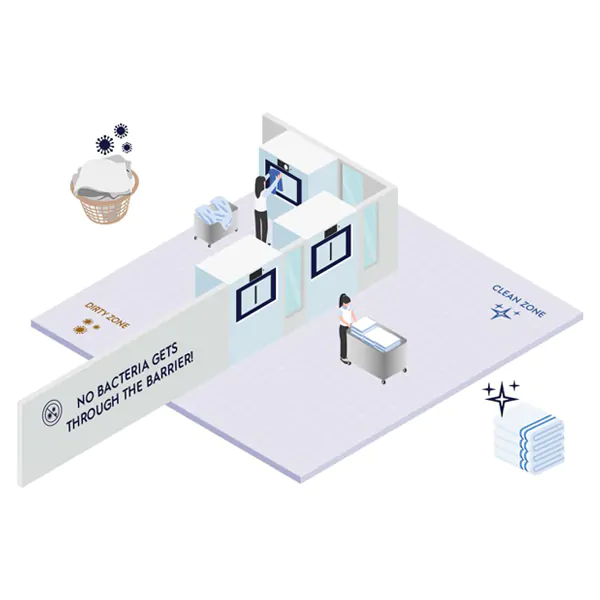
Cross-contamination often occurs while linen is handled rather than washed. Shared trolley routes and staff moving between dirty and clean areas create unnecessary transfer risks. Barrier laundries reduce those opportunities through physical workflow separation.
Barrier laundry design addresses these risks by controlling how linen, equipment and personnel move through the facility. Instead of relying entirely on operational procedures, the building itself supports infection prevention by limiting unnecessary contact between contaminated and processed textiles.
Laundry Layout
Effective barrier laundries are designed around one-way linen movement from receipt through to clean dispatch. Dirty and clean workflows remain physically separated throughout processing:
- Separate dirty and clean processing rooms.
- One-way linen movement through the facility.
- Dedicated clean and dirty trolley systems.
- Restricted staff movement between processing zones, with purpose built wash & change rooms between dirty & clean zones
- Clearly defined loading and unloading procedures.
- Validated washing and disinfection programmes.
Barrier Washer Selection
Only after the overall workflow has been established should equipment selection begin. A barrier washer installation supports contamination control because the machine is built around two physically separated access points. Operators load contaminated linen from the dirty room, while clean linen is removed from the opposite side after the washer once the disinfection cycle has been completed. Interlocked doors prevent both sides from being opened simultaneously, preserving the integrity of the separation between contaminated and clean processing environments.
Process Validation
A barrier laundry system remains effective only when every wash programme consistently achieves the required level of decontamination.
Validation typically includes thermal disinfection, chemical dosing accuracy, cycle verification and documented operating procedures. Health New Zealand’s infection prevention and control guidance reinforces the importance of validated processes, physical separation and controlled workflows to minimise cross-contamination in healthcare laundry environments.
Verification should continue after commissioning through routine monitoring, documented validation and ongoing quality assurance procedures.
Electrolux Professional offers it’s unique Hygiene Watch Dog, which won’t allow operators to open the door on the clean side if disinfection hasn’t been achieved during the wash process.
Planning the Facility
Successful barrier laundries are designed around operational requirements before equipment specifications are finalised. Production capacity, workflow and compliance objectives influence every design decision because they determine how efficiently the laundry will operate throughout its service life.
Planning should evaluate:
- Daily and peak kilogram throughput.
- Forecast production growth.
- Dirty-to-clean workflow.
- Staffing requirements and operator movement.
- Trolley circulation throughout the facility.
- Utility capacity and future expansion.
- Maintenance access.
- Healthcare compliance requirements.
Econic Laundry Solutions evaluates these operational variables before recommending barrier laundry configurations for healthcare and aged-care facilities.
Design a barrier laundry with confidence. Contact Econic Laundry Solutions to plan a healthcare laundry that supports contamination control, compliance and long-term performance.
Frequently Asked Questions
1. What is a barrier washing machine?
A barrier washing machine is designed with separate loading and unloading sides, allowing contaminated linen to enter from the dirty area while clean linen exits into a separate clean zone, reducing the risk of cross-contamination.
2. Which facilities benefit from barrier laundry systems?
Barrier laundry systems are commonly used in hospitals, aged-care facilities, healthcare centres and other environments where infection prevention and contamination control are critical.
3. Why is one-way workflow important in a barrier laundry?
One-way workflow prevents clean and contaminated textiles, equipment and staff from crossing paths, supporting better infection prevention and helping maintain hygiene standards.
4. What should be considered when designing a barrier laundry?
Consider production capacity, workflow, utility availability, staffing, trolley movement, maintenance access and healthcare compliance requirements to ensure the system performs effectively over the long term.